
Is GPS tracking employees legal in Canada?
Not legal advice; consult a lawyer. This is a plain-language overview from a Canadian software company, written from public guidance by Canada's privacy regulators. It isn't legal advice and may not cover your situation. Consult an employment or privacy lawyer about your situation and before writing a monitoring policy. Last reviewed October 2026.
Short answer: in most cases, an employer in Canada can use GPS to confirm where employees are while working, if the purpose is reasonable, the collection is limited to that purpose, and employees are told about it. The details depend on your province and whether your business is federally regulated.
Which privacy law applies to you
Canada has a patchwork of privacy laws, and which one covers your employees depends on where you are and what kind of business you run:
- Federally regulated employers (for example banks, airlines, telecoms and interprovincial trucking) are covered by the federal Personal Information Protection and Electronic Documents Act (PIPEDA) for their employees' personal information. PIPEDA's employee rules don't cover provincially regulated businesses. See the Office of the Privacy Commissioner of Canada (OPC).
- British Columbia and Alberta each have their own private-sector Personal Information Protection Act (PIPA). Both cover "employee personal information" held by provincially regulated businesses. Generally, an employer can collect it without consent if it's reasonable for managing the employment relationship, but must tell employees beforehand what's collected and why. See the OIPC of British Columbia and the OIPC of Alberta.
- Quebec has its own private-sector privacy law, updated by Law 25. Since September 2023, a business that collects personal information using technology that can locate a person must first tell them that it's being used and how to turn those functions on. See the Commission d'accès à l'information du Québec.
- Other provinces (such as Ontario) don't have a private-sector privacy act covering provincially regulated employees. Employment law, collective agreements and specific statutes apply instead.
Location data about an identifiable employee is generally treated as personal information under these laws. The OPC has guidance on privacy in the workplace.
Ontario's electronic monitoring policy rule
Ontario's Employment Standards Act, 2000 requires employers with 25 or more employees on January 1 to have a written electronic monitoring policy in place before March 1 of that year. It must say whether employees are monitored electronically and, if so, how, in what circumstances and for what purposes, and employees must get a copy. Ontario's own guide gives GPS tracking of a delivery vehicle as an example of electronic monitoring. The rule is about transparency: it doesn't ban monitoring or create new privacy rights. See Ontario's guide.
A real example: GPS in BC service vans
In Order P12-01 (2012), BC's Information and Privacy Commissioner looked at Schindler Elevator, which used GPS in the service vehicles its mechanics drove from home to job sites. The Commissioner found the data was employee personal information, and that Schindler was allowed to collect and use it for managing employment, given its purposes and the policies it followed. The decision also signalled that monitoring that is continuous, covert or off-duty would be harder to justify.
The test regulators keep coming back to
Across Canadian privacy decisions, regulators ask similar questions:
- Is there a legitimate purpose? Confirming that a scheduled service visit happened at a client's property is a common business reason.
- Is the tracking effective for that purpose?
- Is it proportionate? Is the amount of tracking more than you need?
- Is there a less intrusive way to achieve the same thing?
Tracking an employee's location 24/7, or after hours, or in their personal vehicle when off shift, is much harder to justify than checking location when they start and finish a job.
Practical steps to keep GPS use reasonable
- Write down the purpose. For example: "to confirm arrival and departure at client sites and resolve client disputes."
- Collect only what fits that purpose. Arrival and departure points instead of a continuous trail.
- Tell employees in writing, before you start, what's collected, when and why.
- Limit who can see it and how long you keep it.
- Don't collect off-shift. Avoid location data outside working time.
- Answer questions. Employees can generally ask what information you hold about them.
How TeamProof approaches location
We designed TeamProof with these principles in mind, because our own crews at Sweepy Maids asked the same questions:
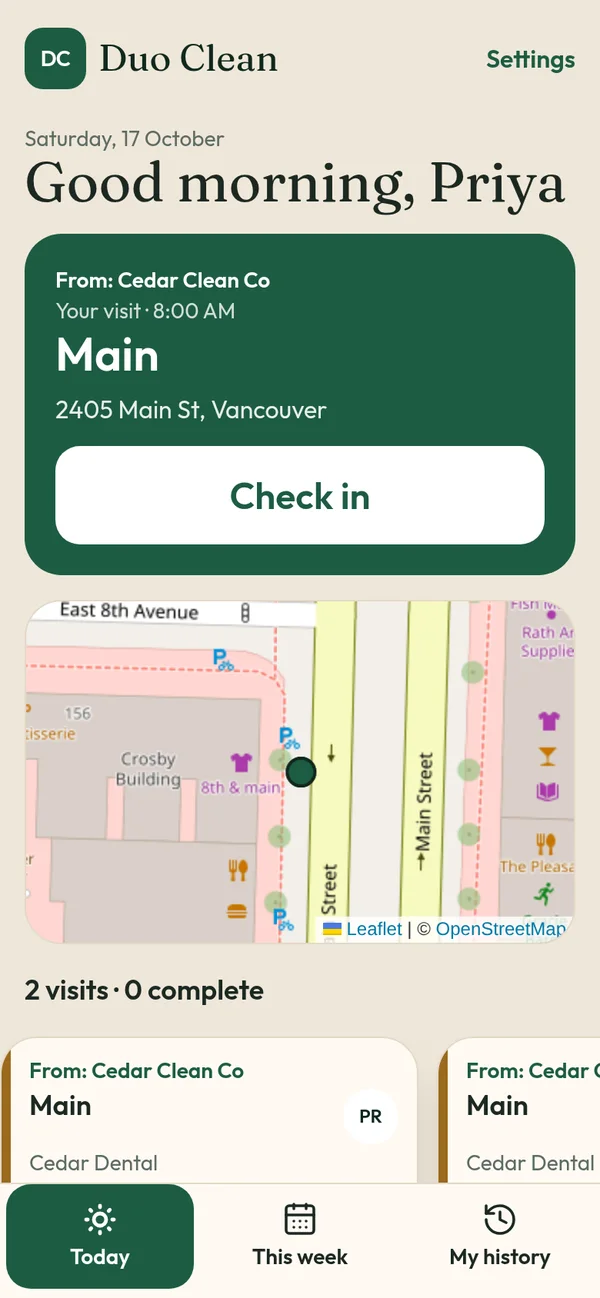
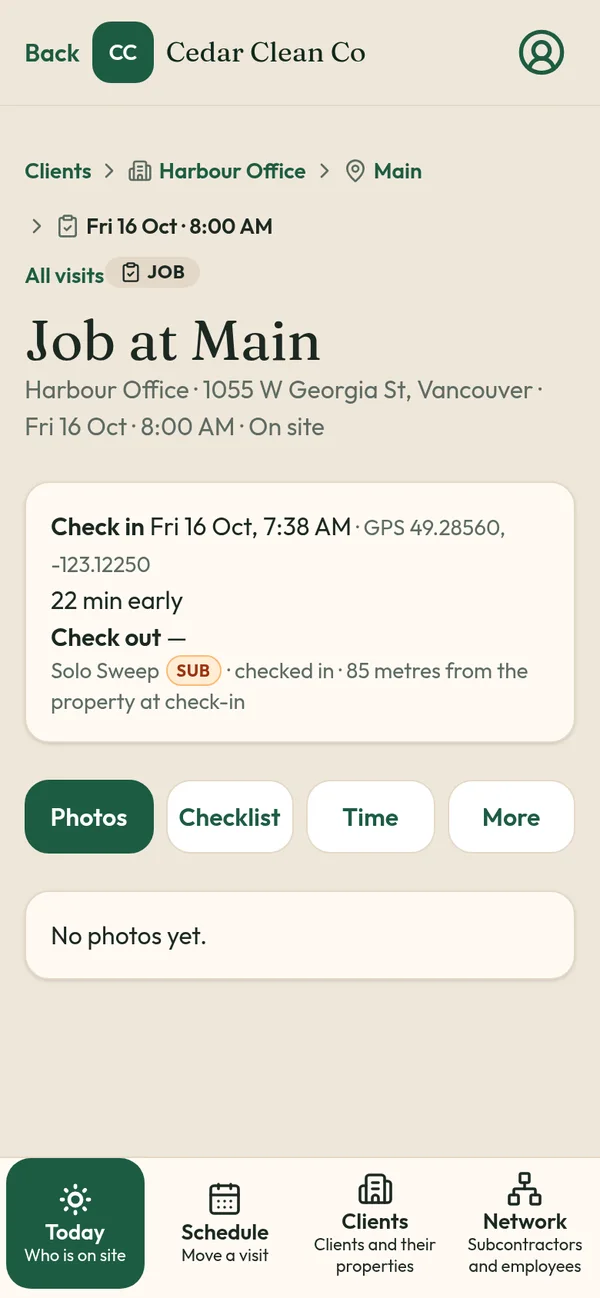
- GPS is checked against the site pin only at check-in and check-out. There is no constant tracking, no route history and nothing off the clock. When a worker opens the in-app camera for visit photos, the phone's location at that moment is saved with the photos.
- The purpose is narrow: confirming the visit happened at that property.
- Clients never see workers' names, phone numbers or pay.
- Workers see a privacy notice in the app and accept it before their first check-in.
- Workers can use English, Punjabi or Hindi, so the explanation is readable.
That doesn't make any tool automatically compliant. Your policy, notice and practices still matter. But a check-in model is far easier to explain and defend than an always-on tracker.
What about subcontractors?
Subcontractors aren't your employees, but their location data is still personal information. Use the same discipline: clear purpose, limited collection, notice. In TeamProof, subs join free and see only their own visits and price. See subcontractor verification.
Related
- How to prove employees showed up to a job site
- Proof of service app
- Connecteam alternative and Homebase alternative
- Best janitorial software in Canada
- TeamProof privacy policy
Official sources
- Office of the Privacy Commissioner of Canada: PIPEDA
- Office of the Privacy Commissioner of Canada: privacy in the workplace
- Office of the Information and Privacy Commissioner for British Columbia
- BC OIPC Order P12-01, Schindler Elevator Corporation
- Office of the Information and Privacy Commissioner of Alberta
- Commission d'accès à l'information du Québec
- Ontario: written policy on electronic monitoring of employees
This page is general information, not legal advice.
If check-in GPS and photos fit your needs, TeamProof is one plan (see current pricing) with unlimited workers. Start a 30-day free trial, no card needed.
Frequently asked questions
Can my employer track my phone's GPS in Canada?
Generally, an employer can collect location for a reasonable work purpose if it's limited and employees are told. Rules vary by province and sector.
Do I need employee consent to use GPS tracking?
It depends on the law that applies. In BC and Alberta, reasonable collection of employee information generally needs notice rather than consent; elsewhere the rules differ. Get legal advice for your situation.
Does Ontario require a GPS tracking policy?
Ontario employers with 25 or more employees on January 1 must have a written electronic monitoring policy, and GPS tracking counts as electronic monitoring.
Does TeamProof track workers all day?
No. There's no constant tracking. Location is checked against the site pin at check-in and check-out, and saved with photos taken in the app's camera during the visit.
More ways to prove every visit
See how all features and simple pricing work for your sites.
- Office cleaning proof
- Commercial cleaning software Vancouver
- Airbnb turnover cleaning
- Mobile patrol app
- Snow plowing documentation
- Landscaping proof of service
- Medical office cleaning
- School cleaning
- Retail store cleaning
- Restaurant cleaning
- Post-construction cleaning
- Window cleaning
- Residential cleaning
- Security guard check-in
- HOA maintenance
- Facility management
- Building maintenance
- HVAC maintenance
- Lawn care
- Property management contractors
- Proof of service app
- Missed visit alerts
- Client visit report link
- Prove employees showed up
- GPS check-in app
- Proof of visit app
- Timestamped photo app
- GPS check-in without tracking
- Verify cleaners cleaned
- Stop no-show employees
- Win janitorial contracts
- Prove a security patrol happened
- Janitorial quality control
- Works alongside Jobber